
ACTION ALERT: Kick Palantir Out!
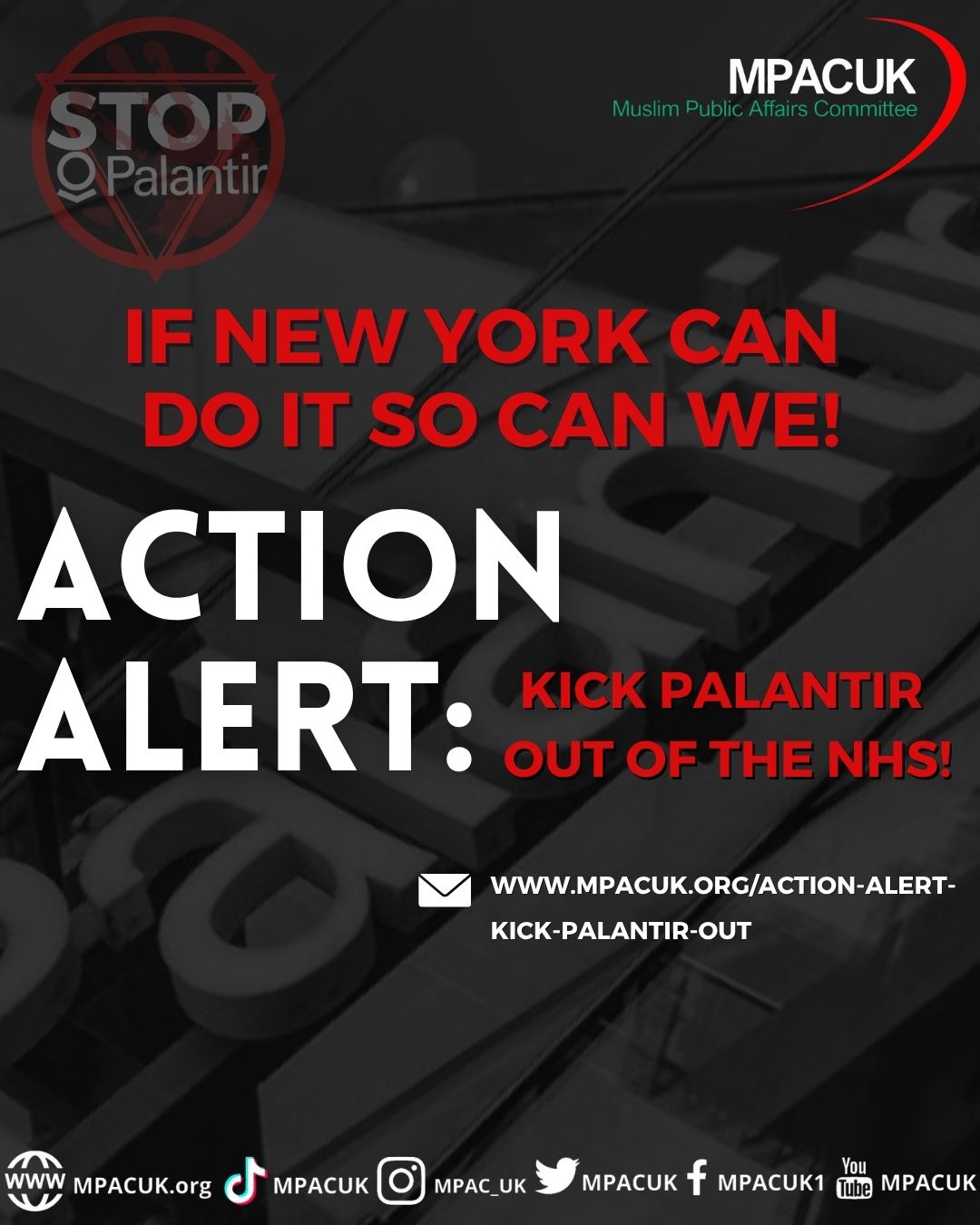
New York City’s public hospital system has confirmed it will not renew its contract with Palantir Technologies Inc., meaning the company will no longer handle New Yorkers’ health data once the deal expires in October 2026.
This is a significant win for grass-roots activism. The Palantir victory shows that sustained organising can succeed even against a politically connected, multibillion-dollar corporation. The NYC hospital contract is ending because activists made it politically untenable for the city to continue the relationship – not because any official body ruled against Palantir.
Today it was exposed that Palantir had a direct role in the Minab school massacre whereby 168 school girls were murdered with a dozen teachers. We must apply sustained public pressure, and don’t accept “it’s just business” as an answer. IF NEW YORK CAN DO IT, SO CAN WE!!!!
How You Can Take Action:
1. Contact The Department of health : dhsc.publicenquiries@dhsc.gov.uk and copy in the Secretary of State for Health wes.streeting.mp@parliament.uk
2. Copy & Paste the email template below
Template
Dear Secretary of State,
I am writing to urge the Department of Health and Social Care to terminate the contract with Palantir Technologies Inc. for the NHS Federated Data Platform (FDP) at the earliest opportunity, including exercising the break clause in February 2027.
My concerns are not simply political or ethical—they relate directly to patient safety, public trust, and the security of NHS data.
1. The Data Is Not Safe with Palantir
Palantir’s core software platform, Foundry, is designed specifically to integrate and analyse data from disparate sources across government agencies. In the United States, Palantir provides software to U.S. Immigration and Customs Enforcement (ICE), where it has been used to link medical records with immigration enforcement data to target individuals for illegal detention and deportation.
The same platform is now being installed across the NHS.
While NHS England has stated that data sharing with the Home Office would be illegal under current law, this misses the point. The concern is not merely what is legal today, but what becomes technically possible tomorrow. If a future government changes data-sharing legislation—as has been openly proposed by some political parties—the infrastructure to funnel NHS patient data into immigration enforcement systems will already be in place, built at public expense and embedded into the daily operation of the health service.
2. Palantir’s Technology has been Directly Implicated in Mass Civilian Casualties
On 28 February 2026, a US strike hit the Shajareh Tayyebeh girls’ primary school in Minab, Iran, during morning classes. Over 171 people were killed, most of them girls between the ages of seven and twelve.
The targeting system used was Palantir’s Maven Smart System—the same technology the NHS is now contracting to manage patient data .
The Maven system, built by Palantir under a $1.3 billion Pentagon contract, fuses satellite imagery, drone feeds, radar data and signals intelligence into a single interface. It classifies targets, recommends weapons systems and generates strike packages in near real time. According to the Washington Post, the software generated hundreds of strike coordinates in the first 24 hours of the Iran campaign, enabling the US to hit more than 1,000 targets in a single day.
The school had been separated from an adjacent military compound by a wall and visibly operated as a school since at least 2016. Satellite imagery clearly showed this. Yet Palantir’s system—fed with outdated intelligence that had not been updated for nearly a decade—flagged the school as a legitimate military target .
The US military has since confirmed responsibility but the question of accountability remains. As the Guardian noted, the Minab strike “had nothing to do with” rogue AI making decisions—it was about a system, built by Palantir, that compressed the kill chain so dramatically that human oversight became a rubber stamp.
This is the company now entrusted with the most sensitive data of British patients.
Palantir’s CEO, Alex Karp, has not been shy about his support for the Trump administration and its military campaigns. The company’s Maven system is being used to prosecute a war that has already killed hundreds of children.
The NHS should not be in partnership with a company whose core business is enabling mass casualty events—and whose systems have demonstrably failed to distinguish a primary school from a military target.
If Palantir’s technology cannot reliably distinguish between a girls’ school and a military installation, how can it be trusted to safeguard the boundaries between NHS patient data and immigration enforcement?
3. Public Trust is Already Being Destroyed
A poll commissioned by Doctors’ Association UK found that 48% of adults would opt out of sharing their health data if Palantir manages the NHS Federated Data Platform. This is a catastrophe for the NHS, which depends on patient data for research, planning, and safe care delivery.
The British Medical Association (BMA) has formally passed a resolution calling for the contract to be cancelled, citing threats to public trust. Local NHS bodies, including Greater Manchester Integrated Care Board (serving 2.8 million people), have repeatedly delayed joining the platform, stating they lack evidence it is in patients’ best interests.
When patients and clinicians lose confidence in the security of their data, the NHS itself is damaged.
4. The Human Rights Record Cannot Be Ignored
Amnesty International has explicitly called on NHS England to cancel the contract, stating that Palantir has “a track record of flagrantly disregarding international law” and that its services contribute to “Israel’s genocide, apartheid, unlawful occupation” through contracts with the Israeli military.
The Minab school strike adds to this record. The same company providing software for targeting systems that kill schoolgirls should not be entrusted with the most sensitive data of British patients. This is not a matter of foreign policy – it is a matter of the ethical standards the NHS should demand of its contractors.
5. There Is a Clear Alternative: Sovereign UK Capability
Your own Science Minister, Lord Vallance, has publicly stated his desire to move away from large contracts with foreign technology companies and to invest in British sovereign capabilities. Ending the Palantir contract would be entirely consistent with this stated policy.
The contract contains a break clause in February 2027. I urge you to use it.
Summary
I ask you to:
Confirm that the Department will exercise the February 2027 break clause and terminate the Palantir FDP contract.
Publish the data protection impact assessments and cyber security risk assessments conducted prior to the contract award.
Provide a clear assurance that NHS patient data cannot and will not be shared with the Home Office for immigration enforcement purposes, and that the technical infrastructure for such sharing will not be built.
The NHS is one of the most trusted institutions in British life. Entrusting its data to a company with Palantir’s record—on data safety, human rights and transparency – places that trust at unacceptable risk.
I look forward to your urgent response.
Yours Sincerely
(Your Name)
Send your MP’s response to : info@mpacuk.org