Campaign Against Anti-Palestinian Hatred

بِسْمِ ٱللَّهِ ٱلرَّحْمَٰنِ ٱلرَّحِيمِ
(Bismillah-ir-Rahman-ir-Rahim) “In the name of Allah, the Most Gracious, the Most Merciful, for his cause and for the greater good of the Ummah today MPACUK are launching one of the biggest campaigns in our history, the campaign against Anti-Palestinian hatred, set out to be a tool to help every Palestinian and those who advocate for their cause for liberation, justice and equality.
وَمَا لَكُمْ لَا تُقَـٰتِلُونَ فِى سَبِيلِ ٱللَّهِ وَٱلْمُسْتَضْعَفِينَ مِنَ ٱلرِّجَالِ وَٱلنِّسَآءِ وَٱلْوِلْدَٰنِ ٱلَّذِينَ يَقُولُونَ رَبَّنَآ أَخْرِجْنَا مِنْ هَـٰذِهِ ٱلْقَرْيَةِ ٱلظَّالِمِ أَهْلُهَا وَٱجْعَل لَّنَا مِن لَّدُنكَ وَلِيًّۭا وَٱجْعَل لَّنَا مِن لَّدُنكَ نَصِيرًا ٧٥
And what is it with you? You do not fight in the cause of Allah and for oppressed men, women, and children who cry out, “Our Lord! Deliver us from this land of oppressors! Appoint for us a saviour; appoint for us a helper—all by Your grace.”
This very verse was revealed in relation to Muslims in Makkah who were being persecuted after the migration to Medina. It refers to oppressed people who are unable to defend themselves and call upon God for help.
The verse is seen as a call to action against tyranny, emphasising that defending the weak is a form of “fighting in the way of Allah”.
Interpretations, such as by Ibn Kathir, highlight that the verse encourages to protect the defenseless and uphold justice.
This verse calls for active defense against injustice by believers. While the verse mentions “fighting,” interpretations of “by any means necessary” suggest using various resources, including diplomatic and financial, to protect the oppressed, which is what we are doing today by creating this much needed tool in the defence of the Palestinians.
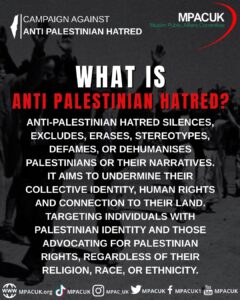
Anti-Palestinian hatred, refers to prejudice, collective hatred, and discrimination directed at the Palestinian people for various reasons. It is a distinct form of racism that targets individuals with a Palestinian identity and those advocating for Palestinian rights, regardless of their religion, race, or ethnicity. While it can overlap with anti-Arab racism and Islamophobia, it specifically focuses on the Palestinian identity and their narrative.
Here’s a breakdown of what the definition would look like, encompassing its various manifestations:
Core Definition:
Anti-Palestinian hatred is a form of racism that silences, excludes, erases, stereotypes, defames, or dehumanises Palestinians or their narratives. It aims to undermine their collective identity, human rights and their connection to their land of Palestine.
Key Manifestations and Characteristics:
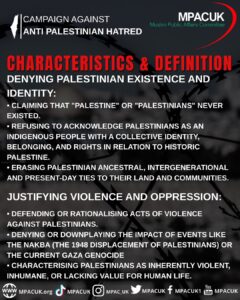
Denying Palestinian Existence and Identity:
• Claiming that “The British Mandate of Palestine” or “Palestinians” never existed.
• Refusing to acknowledge Palestinians as an indigenous people with a collective identity, belonging, and rights in relation to historic Palestine.
• Erasing Palestinian ancestral, intergenerational and present-day ties to their land and communities.
Justifying Violence and Oppression:
• Defending or rationalising acts of violence against Palestinians including any application of collective punishment.
• Denying or minimising the impact of events like the Nakba (the 1948 ethnic cleansing of Palestinians by Zionists).
• Characterising Palestinians as inherently violent, inhumane, or lacking value for human life.
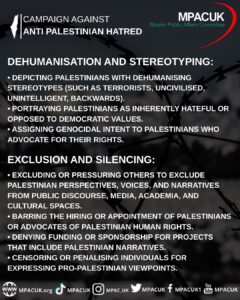
Dehumanisation and Stereotyping:
• Depicting Palestinians with dehumanising stereotypes (e.g., as terrorists, uncivilised, unintelligent, backwards or irrational).
• Portraying Palestinians as inherently hateful or opposed to democratic values.
• Assigning genocidal intent to Palestinians who advocate for their rights.
• Assigning group characteristics such as Palestinians being inherently anti-Semitic.
• Mischaracterising Palestinians as being exclusively a Muslim people or belonging exclusively to a single political affiliation
Exclusion and Silencing:
• Excluding or pressuring others to exclude Palestinian perspectives, voices and narratives from public discourse, media, academia and cultural spaces.
• Barring the hiring or appointment of Palestinians or advocates of Palestinian human rights.
• Denying funding or sponsorship for projects that include Palestinian narratives.
• Censoring or penalising individuals for expressing pro-Palestinian viewpoints.
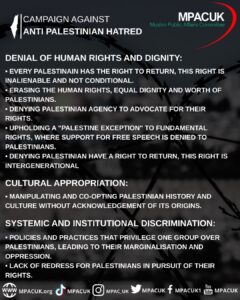
Denial of Human Rights and Dignity:
• Every Palestinian has the right to return, this right is inalienable & not conditional.
• Erasing the human rights and equal dignity and worth of Palestinians.
• Denying Palestinians agency to advocate for their rights.
• Upholding a “Palestine exception” to fundamental rights, where support for free speech is denied to Palestinians or their advocates.
Cultural Appropriation:
• Manipulating and co-opting Palestinian history and culture without acknowledgement of its true origins.
Systemic and Institutional Discrimination:
• Policies and practices that privilege any other group over Palestinians, leading to their marginalisation, oppression, denial of a platform or censorship.
• Denial of the right to protest an institution’s policies towards the Palestinians or Palestine.
• Lack of redress for Palestinians in pursuit of their rights.
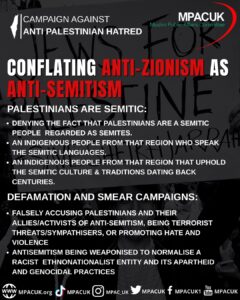
Conflating Anti-Zionism As Anti-semitism:
Palestinians Are Semitic
• Denying the fact that Palestinians are a Semitic people regarded as Semites.
• An indigenous people from that region who speak the Semitic languages
• An indigenous people from that region that uphold the Semitic culture & traditions dating back centuries.
Defamation and Smear Campaigns
• Falsely accusing Palestinians and their allies/activists of Anti-Semitism, being terrorist threats/sympathisers, or promoting hate and violence
• Antisemitism being weaponised to normalise a racist ethnonationality entity and its apartheid and genocidal practices.
• Engaging in practices such as publicly revealing someone’s private information, such as their name, address, or other identifying details, without their consent (also known as doxxing) or other campaigns to intimidate, harass or silence Palestinian advocates.
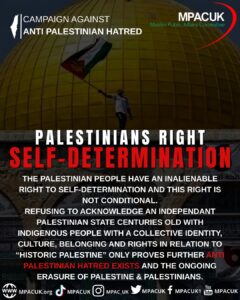
Palestinians Right To Self Determination
The Palestinian people have an inalienable right to self-determination and this right is not conditional. This right includes Palestinians right to return, this includes past, intergenerational and Present day Palestinians with ties to their land and communities.
Refusing to acknowledge an independent Palestinian state centuries old with indigenous people with a collective identity, culture, belonging and rights in relation to “historic Palestine” only proves further Anti Palestinian hatred exists and the ongoing erasure of Palestine & Palestinians.
What Britain should do includes:
Remove any definitions and propaganda that effectively denies Palestinians’ rights to self-determination, that suppresses their voices, that prevents them or others expressing and advocating support for Palestine, or imposes rights of others over Palestinian lives and rights.
• Denying the fact that Palestinians are a “Semitic people” regarded as Semites: An indigenous people from Palestine who speak a Semitic language
• Conflation of “anti-Zionism” with “anti-Semitism” to justify a racist ethno-nationalist entity and its apartheid and genocidal practices.
• Justifying “protection” or “self-defence” whilst crimes against humanity are being committed against Palestinians.
Necessary identification of what constitutes anti-Palestinian hatred and ignorance and an excellent framework for unions and academia to take on board, which must be utilised to stop the negative narrative against Palestinians:
• Britain’s role in the historical and ongoing “erasure” of Palestine is a deeply contentious and complex issue, rooted in its policies and actions during the early to mid-20th century.
Intersections:
• Anti-Palestinian hatred can intersect with other forms of discrimination such as anti-Arab racism and Islamophobia, but it is distinct in its specific targeting of Palestinian identity and narrative. It can affect Palestinians of all religious backgrounds (Muslims, Christians, Druze and others).
• In essence, anti-Palestinian hatred seeks to delegitimise the Palestinian people, their history, their rights including their right to self-determination and their aspirations, often to justify ongoing dispossession and oppression.
Britain’s role in the historical and ongoing “erasure” of Palestine is a deeply contentious and complex issue, rooted in its policies and actions during the early to mid-20th century. Britain’s Role in the Erasure of Palestine:
• Balfour Declaration (1917): This pivotal statement, issued by British Foreign Secretary Arthur Balfour, expressed British support for “the establishment in Palestine of a national home for the Jewish people.” At the time, Palestine was still under Ottoman rule, and its population was overwhelmingly Arab. This declaration is widely considered a foundational element in the eventual displacement of Palestinians and the establishment of Israel, as it provided official recognition from a major world power to the Zionist movement. Crucially, while it included a caveat about not prejudicing the “civil and religious rights of existing non-Jewish communities in Palestine,” critics argue this was largely disregarded in practice.
• British Mandate for Palestine (1920-1948): After World War I, the League of Nations granted Britain a mandate over Palestine. During this period, Britain was tasked with implementing the Balfour Declaration.
• Facilitating Jewish Immigration: The British Mandate facilitated significant Jewish immigration to Palestine without the consent of the Palestinians, which drastically altered the demographic balance.
• Unequal Development of Institutions: While allowing Jewish self-governing institutions (like the Jewish Agency) to develop and prepare for statehood, Britain largely suppressed similar efforts by Palestinian Arabs, hindering their ability to build a robust national infrastructure.
• Land Policies: British policies regarding land transfers often favoured Jewish land purchases, including through compulsory expropriations from Palestinian owners.
• Suppression of Arab Uprisings: The British military frequently suppressed Arab resistance to British rule and Zionist expansion, notably the so called “Arab Revolt” of 1936-1939.
• “Non-Interference” in 1948: As Britain prepared to withdraw in 1948, its declared policy of “non-interference” in the escalating conflict between Arab and Jewish forces effectively aided the stronger Jewish forces. British forces often stood by as Israeli forces advanced, destroyed Arab villages, and expelled inhabitants. In some cases, they even disarmed Arab defenders. This contributed significantly to the Nakba (catastrophe), the mass displacement and dispossession of Palestinians during the 1948 Arab-Israeli War.
• Conflicting Promises: Britain made conflicting promises during World War I, including to Arab leaders (Hussein-McMahon Correspondence) that they would support an independent Arab state in exchange for their revolt against the Ottomans. The subsequent Sykes-Picot Agreement (with France) and the Balfour Declaration contradicted these earlier assurances, leading to a profound sense of betrayal among Arabs.
How to Address the Injustice:
There are various calls and perspectives on what Britain should do to address its historical role and contribute to a just resolution for Palestinians:
• Formal Accountability, Apology and Acknowledgment: Many argue that Britain should issue a formal apology for its historical role in the creation of the Palestinian refugee problem and the dispossession of Palestinians. This would involve a clear acknowledgment of the suffering caused by its policies.
• Truthful Review of Policy: A comprehensive and transparent review of British policy during the Mandate years is advocated, highlighting how the Balfour Declaration was implemented and its consequences.
It is important to understand that this is not the final version, we are constantly in consultation with Palestinians to ensure their involvement in this much needed piece of the puzzle to the pathway of their liberation.